The Buchele Adventure

This is record of the Buchele Adventure, as reported from West Africa.

Friday, August 22, 2014

Return to Bolgatanga

Steve is on a tour of Ghana to visit our Mission Society Colleagues serving in northern Ghana and Togo. Having spent some time with Sue K [her blog], he is now in Bolgatanga, with the Bolga Bartletts, Dave and Ellen.

03-IMG_9283

Ellen and Dave Bartlett

On the field its called it Member Care, when missionaries care for each other, what we in the church would call pastoral care, trouble is, I have difficulty relating to our friends until I can visualize their ministry setting. I come to the north thinking I am coming to meet their friends, experience their ministry, and learn how I can better help, but not long into this journey I realize, as Brian Mann put it so well, “that my deepest spiritual discoveries can be found in observing the lives of ordinary people who seek to practice their faith in ways that are authentic, truthful and unheralded.” [1] Dave and Ellen help me into a spiritual discovery from the highly relational ministry they live, “authentic, truthful and mostly unheralded.”

Steve in 2010, at Bongo Rock

In 2010, our daughter Anna and I spent a week in Bolga, and we have such fond memories from that trip. I was anxious to see it again, and see if I still felt the same way.
Read more about my 2010 Bolga Trip with Anna:
Welcome to Bolga, Crocodile Pond
Bongo Rock, Coming Alive
Navrongo Cathedral, The Art of Barter
Four years ago, Anna and I stayed near the center of town, but staying with Dave and Ellen, their home is on the outskirts, in a community of scattered houses that seem to have spilled out from the road, like an overturned truck. I’m sure there is some order to the houses, some rational in the placement of the traditional, and cinder block structures, but from the ground, I can’t see it.
What I do see is how connected Dave and Ellen are to this community.

04-IMG_8888

Grandpa walking home from the bread store

“Grandpa, hello!” I hear as Dave and I walk to the corner store to buy bread. Along the way Dave drops off some paperwork to be photocopied, he knows everyone by name, and they by “Grandpa” . We do not walk alone either, at every part of the journey, kids or adults join up with us, to carry our bag of bread, to chat with Grandpa for a while, or just joins us along their journey. It is good to see their connection to the people around them.


References:

[1] Mann, Brian D. Spotting the Sacred: Noticing God in the Most Unlikely Places, Baker Books, 2006

[2] Rothman, Barbara Kartz Weaving a Family: Untangling Race and Religion, Beacon Press, 2005

Labels: ,

Tuesday, June 24, 2014

Ashesi Graduates its 10th class

IMG_7663
Graduation was held in the “Cornfield Courtyard” covered by an enormous tarp in case of rain, and to provide shade.  It was a beautiful day.
01-IMG_7644
Students line up to march/dance in to drummers from the village.
02-IMG_7651
Security was noticeable.
03-IMG_7683 
Nana, the village chief arrives.  I like how Nana was invited to be an honored guest at graduation, and fun to see his obvious pride in what Ashesi has become, and the hope this campus, located above his village, brings to Africa.
07-IMG_7749
08-IMG_7726
09-IMG_7744
10-IMG_7746
Students waiting to graduate.
04-IMG_7758
Nana Caster
Nana and Casper (head of operations at Ashesi, and the graduation marshal) afterwards.
05-IMG_7769
Marsha and Suzanne, after.
Selfie
There is always time for a Faculty selfie

Labels: ,

Monday, November 20, 2006

Week-end Trip, Day 3

This past week-end I went to the Western Region of Ghana, with our day guard Emmanuel to visit Vida’s ancestral village, as well as the village where his mother lives. This is day three (Sunday).

See pictures from Day 3

On Day 2 we visited people, on Day 3 they visited us. It is Sunday, and so it begins with a long walk around town where we meet up with Emmanuel’s father-in-law, the Twi singer from last night. He lives at the top of the hill that the town is built around and here he gets a great breeze. We sit on his porch, and he asks our mission. I’m getting the hang of this, but thankfully no cokes appear. I’m about coke’d out. What does appear are goats and chickens, who move in and out of the porch area where we are sitting. He shares a duplex with another family and I watch as his neighbor pulls out a machete and whacks away at a 2x4 of mahogany, and adds the chips to the fire. He is cooking palm nuts. I watch the hens come in and pick up abandoned scraps, and the goat tear at a plastic bag, and think about Bird Flu.

Ghana is a country that has chickens everywhere. When we were waiting to be notified that we were going to Ghana, a bird flu epidemic broke out in Nigeria, a country two countries away and roughly seven hours by car. If bird flu had made it to Ghana, we wouldn’t be here now. I think about all the chickens I we have seen, how they live with the people here, going in and out, mother hens and their little chicks. These are a hardy lot and you never see a dead one on the road, as the stupid ones died off long ago. These are smart and very fast chickens. I think about how hard it would have been to contain an epidemic here, the hundreds of thousands of chickens that would have to be rounded up and slaughtered. It would be unstoppable. Emmanuel asked about it once, and I told him about the epidemic that almost kept us from coming and he said he didn’t believe it, that he would be against the slaughter of chickens to stop the epidemic. He is a wise study, and when even he won’t believe this is necessary, what chance does the rest of the country have?

After we visit a few more people it is time for church, and when we return, Emmanuel’s mother and her brother are there to pay a visit. I ask them their mission, and they tell me they are here to thank us for our visit yesterday. This could go on forever, I think. Me visiting you to thank you for visiting me, you calling on me to thank me for visiting you… We shake hands, I offer them water, as that is what we have, but Emmanuel’s girls are way ahead of me and they have already finished their water. They send Emmanuel away and then plead with me to take him to the US, or sign the papers so he may emigrate. Oh, so this is your real mission, I think. We get this a lot here. People will just come up and ask for us to sign the paper so they may go to US. If only it were this easy. I tell them I don’t really know how this all works, that especially since 9-11, the emigration restrictions are tight, and I tell them I don’t know what I can do to help Emmanuel get to the US.

When the visit is over, Emmanuel asks me to drive them back to her village, Trebuom. Today the road work is complete so it should only be a 15 minute drive (it turns out to be 25). We take Margret (his mother), and Kofi (his uncle, her brother). Margret is 53, and has remarried. Emmanuel’s father died five years ago, but his mother had left him years before that and moved back to Trebuom. Emmanuel is 32 and the eldest of nine children. He is he grandson of one of Ghana’s “Big Six,” (Aku Adjie) the founding fathers of Ghana where were arrested in colonial times and now their faces are memorialized on the ¢10,000 note. As the eldest, he has many of the qualities of and eldest child, a bit of a controller, and always thinking he knows best. So it is an interesting dynamic getting ordered about (I’m a youngest child), and yet I’m his boss, and sometimes I disagree with him, or ask him just how does he think this is going to work out (and it ruffles his feathers)?

For example, Sunday in Ghana, is the day when many people go to the beaches. We had planned to spend the afternoon at the Busra Beach, but one thing led to another, we visited more people--it will only take 10 minutes (that would be 10 Ghanaian minutes, or two hours)-- and by 2pm I wonder if we should go to the beach at all. I lay out the schedule, and it is like he has never thought of time that way. Sure enough, I am within 2 minutes of the schedule as it plays out, except that we leave the beach 30 minutes early, and so there is time for a short tour of Fort Metal Cross, in Dixcove. Later that night we learn there is a riot in Dixcove, and 2 people are killed, but we see none of that when we are there. We see a 17th century supplier slave fort (it supplied Africans to the big castles to be shipped as slaves) that is being restored to turn it into a bed and breakfast. How weird would that be, I think, sleeping in a dungeon where 100s died painful deaths?

Thinking of time as a series of events (with start, duration, and transition times), is a foreign concept. Literally. Time is not thought of that way in the Ghanaian culture. I’m not sure what the metaphor is. We’re in the car driving home and talking about a trip up to northern Ghana, where the first stop would be a town call Kumasi. The end point would be a northern a town called Tamale, (pronounced Tom-a-lee). Emmanuel says it is a eight hour drive to Tamale. We argue about it a bit. “So what kind of hours are we talking about?” I ask. “Ghanaian hours?” He looks hurt. “It is eight hours I say,” he tells me and I counter, “eight hours will just get you to Kumasi,” unless you’re talking Ghanaian hours.” “What does this mean, Ghanaian hours?” he asks. I tell him about yesterday, visiting his mother, and in-laws how he thought it would only take one hour, and I ask, “One Ghanaian hour, and how many rest-of-the-world hours did it take…four and a half.” Ghanaian hours are different.

So we’re back to heading to the beach now after so many delays and when we get there, guess what, at 4:02, I predicted 4pm, so I’m feeling pretty smug, and Emmanuel is surprised I can forecast rest-of-the-world time so accurately. “What time is it?” he will ask every time we get into the car now, to see how close I am to predicting how our programe will play out.

I guess what I had begun to notice that first night, was that if I took time to involve myself in the schedule of events, asking questions about this or that aspect, pointing out the unrealistic parts, that it was possible to stay on a schedule measured in rest-of-the-world hours, but it didn’t just happen naturally.

So now it is 11:15am on Sunday, and worship at the Methodist church has been going on now for one hour and fifteen minutes give or take an hour. We drive—it is a two block walk, but this is something he loves, showing up in a big car, the only car in the parking lot. This is a new experience for me, showing up half way through a worship service. Its not new to a lot of people, but for me this is a first. We get in just in time for the announcements—I fall asleep, and Emmanuel is aghast, but it is hot, I’m dressed in funny cloths, and for 20 minutes they have been giving announcements in Twi, and it is feeling like Community Radio again, and its payback for the lost sleep that morning. My eyes shut, and I’m not praying, not even close. He nudges me, just like Suzanne does sometimes. Then it is the offering, actually they do this twice. Here, and in many of the churches we’ve worshipped at, instead of passing the plate, you go forward (dancing along the way) and place your offering in a basket up front. If you are a tither, then you also place a notebook along with your offering so that the elders can record your contribution and return your book during the service. We don’t go up the second time, and the elders of the church approach us, and ask “What is your Mission?”

Next thing I know I’m in front of the church being introduced, “I bring you greetings from Texas, US,” and the pastor comes to stand over us and prays, in English. Then it is time for the sermon, and the repeated phrase is in English, Put your whole trust in God, and it is only 15 minutes long. This is the shortest sermon I’ve heard in four months, and then church is over, and we go out and shoo the goats from under the car and drive all of two blocks home, except that we don’t drive home, we go to the next town over to visit his sick cousin, whom he found out was sick only this morning. It will only take 10 minutes, he tells me (10 Ghanaian minutes I think). Two hours later, I’m wondering out loud if we should bother going to the beach at all.

We do and Busra beach is wonderful and unlike any we’ve seen in Ghana, more like the beaches of Belize, where the water is waste deep about a half a mile off shore and not rough at all. I’m the only one who goes in the water, Emmanuel and the girls stay on shore. Ghanaians are afraid of the water, and in most places they have a right to be. Ghana has some of the nicest beaches and strongest undertow I have ever experienced. It really feels like someone is pulling at your ankles when the tide goes out, and I’ve heard of a legend about the witch of the sea who steals people and sucks them out to drown. But Busra is different, and I hope to bring my family out here because swimming by myself isn’t as much fun as it is with the family.

We are home by 7pm, just about what I predicted, and dinner is fufu and light soup, it is wonderful, but I am not that hungry, plus one of our missionary friends told me the key to not getting sick when you are going on village visits like this is to eat “small, small” (to eat small portions).

When Ghanaians want to say little, they say “small, small”. I wonder if it is a Twi-ism, anyway it has crept into our family language where we say “small, small” now, and it always brings a smile. Tonight ends as yesterday ended, with Vida absent, Emmanuel, out looking for her, and the girls and I singing along with their grandfather, but we have visitors.

I am told they have come to greet me. This is Vida’s sister and husband from yesterday, the first home we visited yesterday morning. They have come to thank me for my visit and now want a ride home. I tell Emmanuel that it is dark and I don’t feel safe driving these roads at night. He asks again and the singing grandfather steps in for me, pleading that I am tired and can not drive them. I feel bad saying no, but I am beginning to get the feeling that everyone wants a ride in the car, and while I don’t mind, I do mind at 9pm on a very dark night. In the distance I hear thunder. We walk them to the Taxi station and for ¢20,000 they take a taxi. I would have gladly paid that two dollars not to be on the road that night.

So we go inside and sing songs, and I hear more Twi versions of standard hymns plunked out on honky-tonk guitar. I am looking for another song, and grandfather says, “Please pastor, it is almost raining.” So what I think, we’re singing. “Please, pastor, it is about to rain.” Oh, I get it, he can’t leave until I allow him, and so we stand, I thank him for visiting and singing, and then tomorrow promise to visit him at his workshop. He walks home before the rain begins.

As I go to sleep that night I am thankful that I am not out driving strange dark roads in a downpour that will last most of the night.

See pictures from Day 3

Labels: ,

Friday, November 17, 2006

Week-end Trip, Day 2

Day Two, Saturday.

This past week-end I went to the Western Region of Ghana, with our day guard Emmanuel to visit Vida’s ancestral village, as well as the village where his mother lives. This is day two.

See pictures from Day2

The plan for the day (or programe as it is known here) is to go visiting relatives, attend church (Emmanuel’s family is Seventh Day Adventist, so they worship on Saturday) and then in the evening, for Steve to deliver a lecture on Marriage, Families and Child Care. I have some serious reservations about giving such a talk, the greatest being that when one proclaims to be an “expert” on something, one invites trouble into their life. So while I may have a very good marriage and family, who needs trouble? So I have reservations about giving such a lecture. Another reason is that I think Ghanaians practice family life much better than we Americans. For example, here we are in the ancestral village of his wife, not far from the village of his mother, not far from the village of his ancestors, and he knows a lot of people, and they know him---by sight. “Adjie,” they say with this huge smile that seems to say “what are you doing here?” He has married the local girl, and now is a part of their family, and they know him.
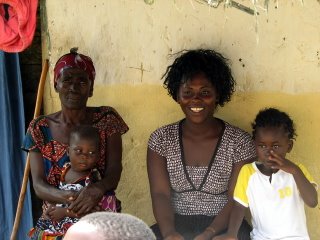
I actually wonder if Mr. Emmanuel Adjie has some alternative motives for wanting me to talk about marriage, perhaps he wants me to lecture his wife about marriage, and has picked her home church as the venue. The Tuesday before we left I ended up doing some cross-cultural marriage counseling for them, something I know I am not qualified to do. It seems that he and Vida have were having a WarWa, which means very big fight, and in his anger he has said some things he regrets, and while he is at work (guarding my home), Vida has taken him up on those words, and moved out with their youngest daughter, Ruth. She has gone to stay with a sister in a part of town he does not know. After much WarWa, her kid brother, Cory, (remember Cory from day 1?), has delivered her to our house, and now I’m sitting in our living room, listening to their stories. Emmanuel just wants me to order her to come home, as the white man, authority figure, boss, and I won’t have anything to do with that, even for him. Crazy me, I think they should actually work things out, and apologize for unfortunate choices they have made. At the end of the day, Vida has moved back in, and the trip is back on and so here we are in her home town, going to visit relatives before going to church.

The villages we are going to are about 20 minutes away by dirt road, except the dirt road has washed out and is being repaired that day, so we take the long way around, about an hour. Church is at 10am, we leave to go visiting about 8:30am, and each visit takes about an hour and even I can see it isn’t going to work out.
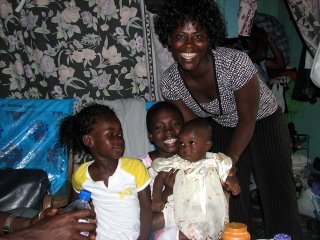
We go to the first village, Ayem, to meet Vida’s elder sister. Most of the transactions are in Twi, and so I really have no idea what is being said other than the occasional obrunie, or Methodist, which I can pick out. Twi is a funny language in that they freely mix in English words, like numbers, or western concepts that have no Twi word equivalent. The general form is to be invited into a house, and to sit down. If there is a place of honor, I am directed to sit there, if there is a fan, it gets pointed at me. Immediately someone will ask, “What is your mission?” and one of us is expected to go into a narrative about what has brought us to this point in our journey. Later Vida’s father explains to me that they ask this so the people will know if you are being persued, so they may hide you under their bed if necessary. When the narrative is done, everyone shakes hands, snaps, and bottles of cokes appear. I am the only one who is not expected to share my coke, and the conversations really begin.

Have I told you about Ghanaian hand shakes? In the course of a typical conversation I’ll shake hands five or six times. It starts with a western handshake, then moves to a brother handshake, and then back to the western one, and then we carefully arrange our middle fingers so that we release, we can snap our fingers in unison, and if we mess up, we’ll try again.
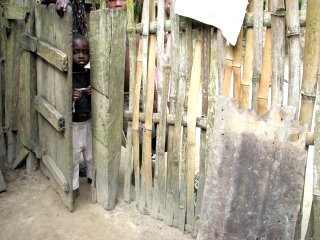
The next town we visit is Trebuom. Trebuom is down another dirt road and is the town that Emmanual’s mother lives in now, and the one Vida was born in. Her grandmother still lives there, her mother died years ago. On the way to Treboom we see a Palm Wine Tapper, and stop and get out to examine the process. Palm Wine is a sweet wine that comes from the sap of the palm tree. They uproot the tree down, let it sit for a week and then make a square funnel shaped hole near the top, and a hole on the bottom in which the sap drips out. The sap is collected in gallon jugs, the jugs are poured into 50 gallon drums (previously oil drums), and then allowed to ferment for a week.

Emmanuel, Anna, Ruth and Vida all sample the milky palm wine; I’m not that brave, so they give us a bottle to taste later, but over the night it exploded (the fermentation process was still very active). It takes 8 trees to fill a 50 gallon barrel, he tells me, and there are 250 trees in this area to be harvested.
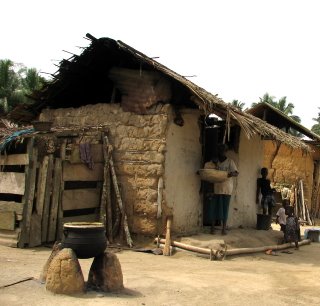
Trebuom does not have electricity, and so the village you see is different than many of the other villages we will visit. The huts are mud and bamboo instead of concrete, and there are not power poles connecting a web of wires strung haphazardly overhead. There are no TV antenna stretching to the sky on tall bamboo polls. The government has plans to move the town five miles down the road, halfway between the towns of Mpoho and Bopp. When the town has moved, they promise a regional hospital and to bring power (“light”) to it, but until then, it remains unchanged. We visit Emmanuel’s mother and her husband, along with Vida’s grandmother and her aunts. While Vida is talking, the village children take us to the cocoa plantation, and we pick cocoa pods. Vida gives me some drying cocoa beans to taste, and Ruth shows me how to eat them. Yes, it takes like (bitter) cocoa, wow!

The longer we are in Trebuom, the more children follow us around. They will stay just out of reach, and their eyes watch me. Anna and Ruth snuggle, and rub my hairy arms, the village kids are fascinated, and it seems that everyone in the village comes by to have a look at the obrunie. We follow the usual format, what is your mission, cokes, shake hands again, snap, and then they talk. I smile and play with the kids and try to shake their hands, but they will have nothing to do with me, except to stare. It is now 11:30am, and church service we were planning to attend is well over, I think.


At noon we head back to Mpoho, and by 1:30 we are back, where we change into church cloths, long pants, long sleeve shirt and a tie. It is too hot for this, I think. All the way back Emmanuel has been fielding calls from the people at the church asking where we are. He is exasperated, and confesses he thought the visiting would take no more than an hour and here it has taken over four. In the original plan, he was to preach that Sunday in church, but for some reason that plan has changed and it is a good thing, since we missed church, but not the Harvest. They waited until we arrive before starting the Harvest.
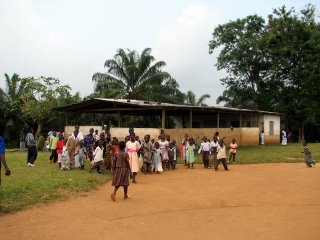
Harvest is a quarterly event in the local churches here. It is a fund raiser in which several churches will gather to help each other out. A well-to-do person is selected as the chairman, and about 30 others are on the committee. As far as I can see, these are figurehead positions for this particular Sunday. Some churches auction off produce that people have brought from their farms and gardens, but this afternoon it is more of a talent show of different groups of people getting up and singing in incredibly tight four part harmonies. Of course, I have my guitar and so I sing too. During the singing people come forward and put money in a bucket. Sometimes people dance all the way up there and make a great show of putting money in the bucket, other time they is like what I imagine I would be like, embarrassed.

The first time I am introduced, and I sing the song, Meet With Me, a fun little ditty, and then I sit down and listen as there is more speaking, and a few other groups perform, including the chairman, who is actually quite good. The congregation is not what I had expected, mostly children from 5 to 18, and then a group of parents, and about 30 other adults who are part of the committee. They are expected to get up and contribute from time to time. Vida is elsewhere, visiting with family I guess.

The first time I sing, the congregation doesn’t know what to do with me. The second time, I am introduced again, and I bring them greetings from Texas and the US. I sing a song about marriage that Suzanne and I wrote when I was in seminary (Kelly & Melina's Wedding Song). They are clapping and I hear people harmonizing on the refrain. I sit down, and later I am introduced for the third time. Emmanuel and I are having a discussion.

“I don’t think this talk is the one I’m supposed to give,” I say, pointing to the prepared talk on marriage. “These children,” I tell them, “they are too young to be married.” “But Mr. Steve they have already announced that is what you will speak on.” We go back and forth, and then he says to tell them that this is what God has laid on my heart to share with them.

This Adventist church has gathered with another church called Trumpet, and together they are doing a Harvest to raise money for a building. Right now we are meeting in an outdoor school assembly hall. So when I am introduced again, I tell them about Foundation, and how it was just four years ago that we moved into our first building, and how I look forward to the day when you will have a church building of your own. I begin the prepared text, going into God, Family and Everything else, before launching into The Emergency Sermon.
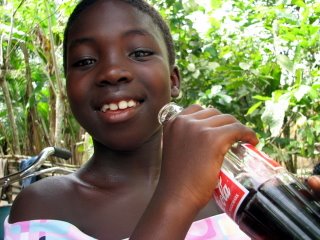
“As a missionary kid,” an MK once told me, “You must be ready to pray, preach or die at a moment’s notice. Since I’m not a missionary, then all I have to be ready for is to pray and preach, and so like most preachers I know, I always have an emergency sermon in my brain, ready in a moment’s notice just in case we need to break the glass and use it. For me this sermon’s latest incarnation was called God’s FAQ, or Frequently Asked Questions, but the twist is that it is God who asks us the questions. It’s a pretty generic sermon that can be adapted to many situations and uses the Bible to ask people to self examine their lives to see how God could use them. I can’t tell you the number of times I’ve had to pull out this sermon, and today, I am glad I have it.

A funny thing I’ve noticed about the Ghanaian churches: they are loud. I don’t know why, but they always have the amp turned up so loud that it distorts. So loud that it has long ago blown the speakers. So loud that I wonder if they even need to put potentiometers on the volume control knob, or would an on/off switch achieve the same affect? So the pastor and I pass the microphone back and forth, English, Twi, English Twi, very loudly.

I’m not sure my preaching connects. Preaching is so contextual, and to be effective you have to know the context, otherwise, as Bob Shelton[1] once said, “you’re just bootlegging the gospel.” Today I felt like a bootlegger. Before it is time to leave, they ask if I have one more song, and so I pull out one from long ago that has a cool whistling part at the end. The congregation really gets into this one, and when I start to whistle, the place erupts with joy. It is fun to finish well, and Emmanuel manages to slip us out after the song, but well before the Harvest will be over. It is now 5pm and we have been visiting or at church all day.
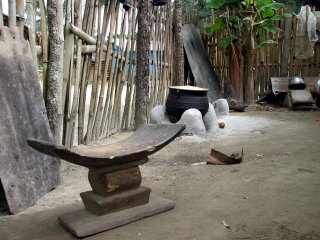
At night, after a wonderful dish of Groundnut Stew and pounded rice balls, I sit around singing with Emmanuel’s girls and their grandfather. Vida is off talking with her family so she misses her girls singing This Little Light of Mine, Tradin’ My Sorrows, and Shout to the Lord. They bring out a hymn book and we find songs to sing like I Surrender All, and Old Rugged Cross, and then their grandfather sings a verse in Twi, their local language. How fun. I wish I had a recording of this very African voice singing To God be the Glory, in Twi, with this honky-tonk guitar behind it.

Then it is off to bed to await the roosters and community radio, bright and early, tomorrow morning.

See pictures from Day2

[1] Dr. Robert M. Shelton was my Sr. Preaching teacher, and later president of Austin Seminary (www.austinseminary.edu)

Labels: ,

Wednesday, November 15, 2006

My Weekend with Emmanuel - Day 1

This past week-end I went to the Western Region of Ghana, with Emmanuel (our day guard) to visit Vida’s ancestral village, as well as the village where his mother lives.


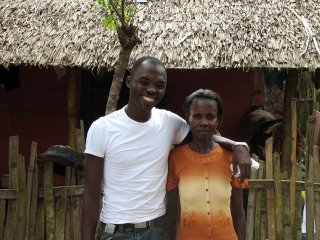
[Kofi (Emmanuel's Uncle) & Steve practicing a snap-handshake]


This is a trip Emmanuel and I have been planning for several months, and as the day neared I must admit I felt some anxiety about giving myself over to another culture. I think I was more brave before I “ate something” and got so sick the last time, and so there is great fear that it might happen again. Emmanuel has gone to great lengths to make sure that it does not happen, bringing Vida to cook for us, enough water to last the week-end, and staying in a guest house.

Because Emmanuel is our day guard, he had to ask for some time off. If the security company found out that we went away together, he could be transferred to another house, as they do not like the client and guards to become close. So we had to dash his supervisor, and a relief guard so that we could leave early. Turns out we had to dash that relief a second time as his supervisor had kept all of the dash he was to split.

We left Accra about two hours later than we had planned and hit the massive traffic jams that are a fact of daily life for those leaving Accra. There are two routes out of town going west that connect to the same highway. One route is shorter, the other longer. The short one is a two lane undivided road (that splits into four and is choked with TroTros) and the longer route, is a three lane divided highway (and also choked with TroTros). We take the former, the one route I told him I did not want to take. “I show you shortcut,” he says, and I’m all for that since this route is always a mess. I don’t know what it is about Emmanuel, but when I tell him that I do not want to take a certain route or go to this certain place, it turns out to be exactly where we go. So now we’re caught up in this dangerous, highly fluid congestion of traffic and I ask, “So when I told you the Tema Highway Extension was the one place that I did not want to go to, you took me here, why?” He does not answer and seems genuinely surprised the traffic is this bad.

This is a cross-cultural weekend, and so I know there will be other issues, like the African way of handeling money. I’ve noticed this before, that when we’re at the market, Emmanuel likes to negotiate the price in the local language, and then tell me the final price in English. He takes my money to pay for it, counts it and hands it to the seller. If there is change, Emmanuel pockets it. I didn’t notice this in the early days, and thought maybe I was giving Emmanuel the money to count, to make sure it was the right amount. Now we’re on the road picking up last minute things from the hawkers that show up when the traffic flow slows. Things like bread. When you come from Accra, the tradition is, you bring a loaf of bread. There is actually a town that specializes in bread, the once we’ve called “market town” in other entries, that the one obrunies here have nicknamed Bethlehem, because of the bread venders. Lots of venders selling bread. Bethlehem means “House of Bread,” and so Vida and Emmanuel are picking out different loaves here and there and it seems like the price is always $15,000, and all I have is ¢20,000 notes. The ¢5,000 note change never quite seems to make it back to me.

Its dark now, and we have been on the road for 4 hours, and we’re nearing Cape Coast. It is time to stop for dinner, and I’m getting tired. I do the calculations in my head 90 minutes for dinner, and still two more hours drive, and we’re talking midnight before we get to the guest house. Too late for me. I propose we spend the night in Cape Coast because as it gets later, the TroTros get crazier, and it is already unsafe. We pull over to a travelers gas station and in we go to buy more bread and ground-nuts (peanuts). I’m thinking this is a snack dinner, which is great, we’ll be on the road that much quicker (turns out we were actually buying breakfast). This time when the change comes, I grab for it. There is a bit of a struggle, and he makes up some excuse about wanting to dash the store clerk, and I say no, which is funny since he is always telling me to not dash people. Like earlier when we stopped to fill up the gas tank and the bill comes to ¢605,000, and just like always he takes the money, counts it, and as he is walking away I say, “dash the attendants ¢5,000” and he says “Nope!” Later I ask the attendances, “Did he dash you?” They say no, and I’m pulling out money to dash them, and he walks up. “Why did you not dash them like I asked?” He says “We do not dash attendants,” well I do, and the guy who lent us this car, asked that we do.

Now Emmanuel was an filling station attendant many years ago and so I ask him if people ever dashed him, “yes” he says, and did you not like it when people dashed you? “Yes” and so why did you not dash them, and he has this story about how they had tried to cheat me, and I’m thinking, but you pocketed their dash, and so who is cheating whom? Later I will kick myself for not just going more with the flow of things. Actually, I think I am going with the flow pretty well, especially since there is a steady flow of money out of my pocket. Obrunie ATM.

They say that one of the differences between the Western World and Africa is how westerners will let money ruin friendships. The joke in the West is if you want to lose a friend, just loan them money. That would never happen here. Money is treated like a community resource, maybe like water from a well. A neighbor asks for some water, and of course you would share, so it is when friends/family/neighbors ask for money, if you have any, it is theirs for the asking. I’m trying not to be annoyed at his sticky fingers, and figure I’ve brought three months of his salary for the week-end, and so we should be able to make it last.

After wrestling over the change, we come out of the travelers store, it was an actual nice store, up to 7-11 standards, clean, well lit, and air conditioned. Outside side we find Vida has commandeered a table from an outside bar, and found chairs to put around it. The table is set and she has brought a tackle box full of Jollif Rice, and she serves us.

In the early planning stages of this trip it was to be Emmanuel and I on a week-end adventure, and then he decided to bring Vida along, to cook the food, so I would not get sick. Since Vida is coming, so do his girls, Anna (8) and Ruth, who just turned 5. When we pick the family up, Cary, Vida’s little brother along too. Cary has been mooching off them for the past few months, and I gather is in the doghouse with Emmanuel, something about loaning him cedis he was saving for his girl’s school fees, and now that loan has turned into a dash. I rarely hear Cary speak and never in the presence of Emmanuel, he is more of a quiet shadow the whole week-end, who washes the car every morning before I wake up. So its all six of us around the table eating Jollif Rice.

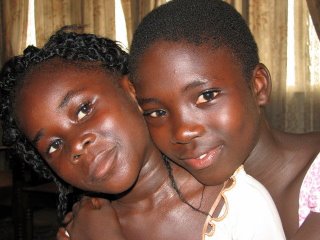
[Ruth & Anna]

The Jollif Rice was great, the setting, a little surrealistic. We’re sitting under the African sky, eating African food and Elton John is blasting out of the bar’s speakers. “Good bye Norma Jeanne, though I never knew you at all..”, It’s his tribute to Marilyn Monroe, the one that so mournfully calls her a candle in the wind, that burned out too young. At 9pm we’re back in the car heading down even darker unknown roads, and I notice something about time that won’t be obvious for another few days.


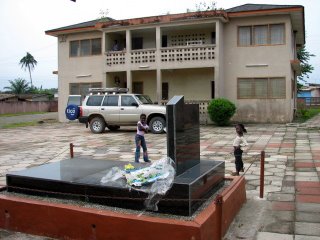
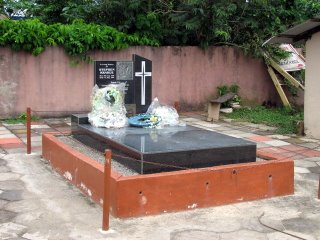
[The backyard grave of Stephen Krakue]

By 10:45 pm we have arrived at the “Guest House,” in the town of Mproho (pronounced m-po-ho). The guest house is a two story building former home of one of Mpoho’s favorite sons, Stephen Krakue who died two years ago and is buried in the back yard.

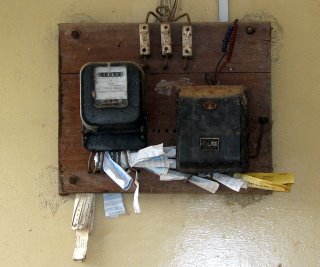
[Unpaid bills on the electric meter]

Now his elder brother operates it as a guest house, but how long that will continue seems uncertain. There is some trouble paying the utilities, and the water has already been cut off and looking at the electric panel, the light seems to be next.

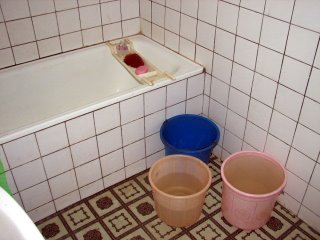
[bucket showers]
Hello bucket showers. Since there is no water in the building (or as they say, “the pipe is not flowing”), water has to be brought upstairs in buckets from the community water tap across the courtyard. Emmanuel had warned me about this, they had asked “Will obrunie bathe in bucket?” except when he asks it sounds like he is saying barf instead of bathe. “Will obrunie barf in bucket?” and I’m thinking, I hope not, but he is talking about bathing, and I assure him it would be OK.

I have to laugh, because when we get there, there are three buckets. One of the “Steveisms” I talked about with staff was the theory of the three buckets, and here they were.

The Three Buckets
In life there are three buckets: faith, friendship/family and work/calling. Each bucket needs a place to get refilled, the faith bucket at worship; the friendship bucket, with friends and family; and the work (or meaning) bucket as we follow our calling. The problem comes when we start combining buckets, say our complete set of close friends come from work, but then something happens and we get fired. What about those friends and how awkward is that going to be the next time we see them? In this example the work and friendship buckets were combined and when the work bucket went bad, the friends bucket was spoiled too. Combining two buckets is dangerous, combining three is lethal, and therein is the problem with work in the church. Too often, we church workers combine our three buckets, we work at the church, our friends are at the church, and our faith gets fed in church. But what happens when an unpopular decision is made, one that our friends don’t agree with, and they take it out on us?

At first the three-in-one buckets felt great because all three buckets were always full, friendship, faith and work. But then something happened, or to put it another way, someone pooped in the bucket, and now it stinks. It stinks to work at the church, and our friends are angry with us, and the one place we fed our faith, also stinks. Someone pooped in the bucket, and the there buckets were not distinct, they all stink.

Its not a matter of if poop will appear in one of the buckets, but when, and when it does, wouldn’t it be great if at least one of them didn’t get some stink in it? In those times, its only the non-stinky bucket that provides the support we pastors and church staff need to get us through the current poop producing crisis. But working in the church it is hard to keep the buckets distinct, therein lies the problem.

Fortunately, there is a toilet in this guest house, so nobody has to poop in the buckets, but we do have to empty them into the toilet to flush it, so we do wait until it is brown to flush it down.

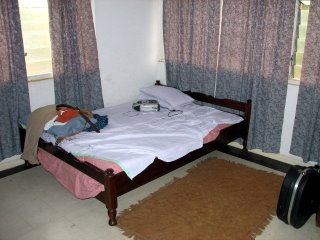
[picture of my room]

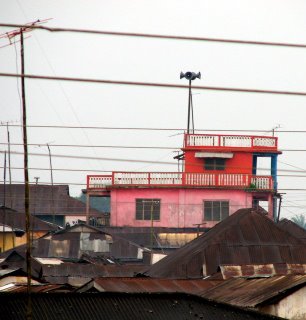
My room is nice, and large by Ghanaian standards. It has a great overhead fan, lots of air flow and a comfortable bed. I sleep alone in my room, and everyone else sleeps in the other room down the hall We all sleep well, until 5am (OK – so the roosters started at 4am, but you get used to that in Ghana). At 5am, its time for Community Radio. Community Radio is a loudspeaker system that blasts from atop of a tall pink building, the tallest in town. The broadcast, if you can call it that, is a man shouting announcements for 45 minutes in Twi or Fante. That first morning, in a sort of half awake state I thought it was the imam at the local mosque calling the faithful to morning prayers. I thought he was praying for me. Late in the afternoon Emmanuel translates one of the announcements when they are being repeated. “Chainsaw operators are required to attend a meeting tonight at 7pm...” The last morning we are there, I hear the guy singing Happy Birthday, but this morning, our first, it has brought me to full awakeness, and I’m ready to begin the adventure.

[This is the Community Radio broadcast tower]
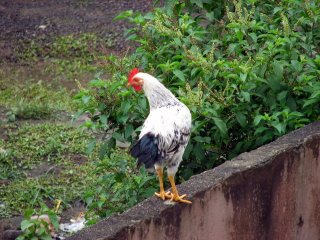
[the 4am Rooster, I'd prefer to change his name to "stew"]

Labels: , ,